

General
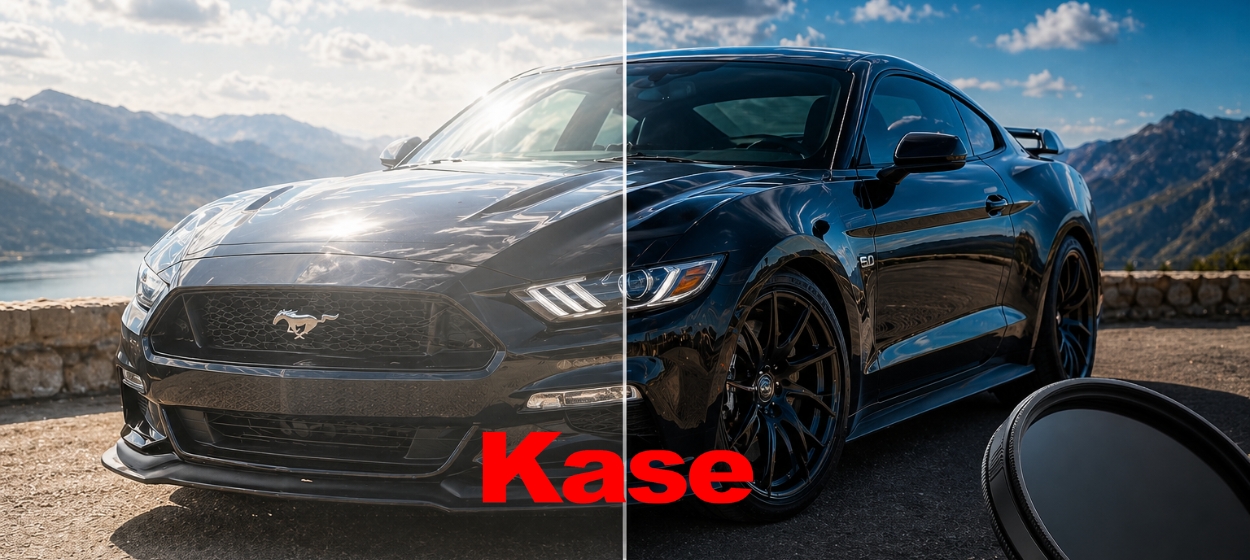
How a CPL filter transforms car photography and why it matters
Every car photographer knows how difficult it can be to deal with too many reflections on the photo. Sometimes you want them, but more often, you want control over them. That’s exactly where a CPL filter comes in. It gives a simple way to control reflections and improve colours in real time. Keep reading to learn why and how to use a polarising filter and improve your car photography.
Go to:
Why use a CPL filter for car photography?
Top effects of CPL in car photography
When to use a CPL and when to leave it off
How to shoot with a CPL: tips and techniques
CPL or ND filter for car photography
So, is it worth it?
Why would you need a CPL filter for car photography?
One of the main challenges in outdoor car photography is reflections. Because of them, the windshield looks white, the car paint acts like a mirror and doesn’t show the real colour or even worse, you have reflections of some objects or yourself on the car. You may try to fix it by finding good light and angle or post-editing, but it is quite hard.
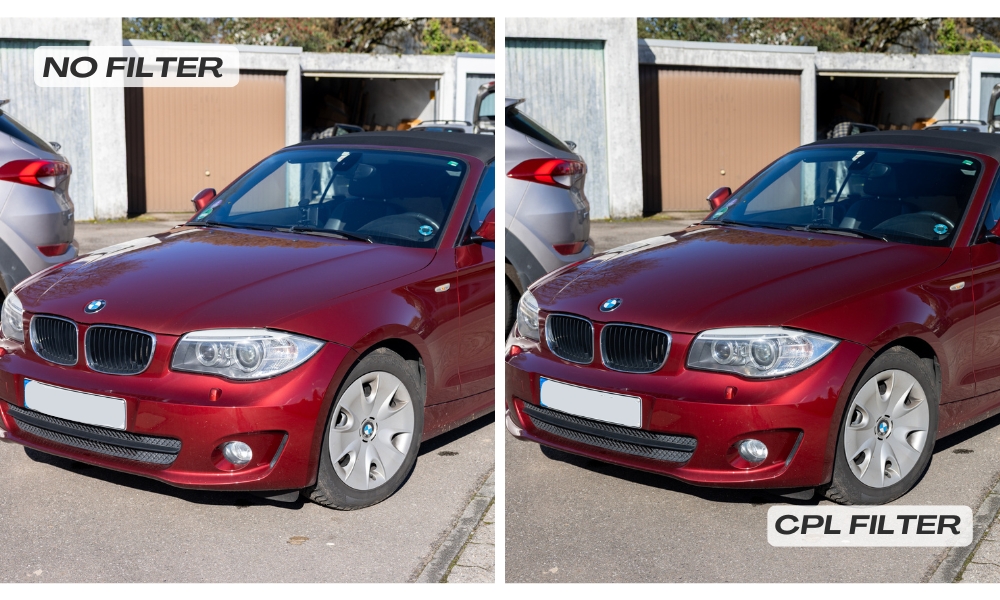
With a polarising (CPL) filter, you can reduce those reflections and reveal the actual colour and shape of the car. It is designed to reduce reflections and control how light enters your lens.
The biggest advantage of using a polarising filter in car photography: you can see the effect immediately in the viewfinder and control it by rotating the filter. So, you shoot a car with enough details from the start.
Top effects of a polarising filter in car photography
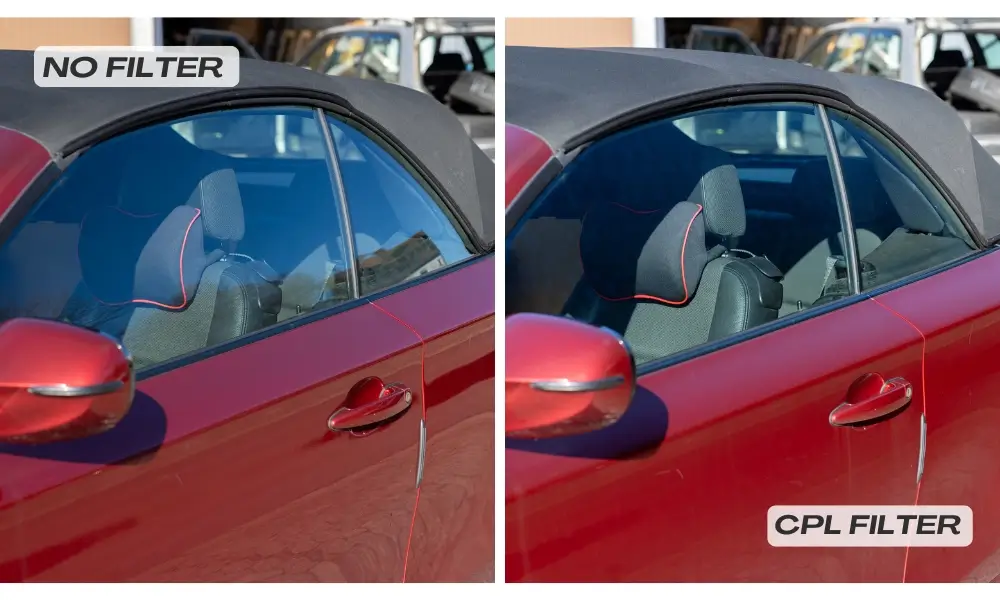
1. Minimised reflections
This is the main reason photographers use a CPL in car photography. It helps to:
- Cut reflections on the windshield and side windows
- Reduce glare on the paint and show the real colour
- Avoid reflections of objects and people in the paint
It doesn’t remove reflections completely, but it gives you control over how strong they appear.
2. Richer colours
Once reflections are reduced, the car’s actual colour becomes more visible. Paint looks deeper and more defined, and metallic finishes get more clarity. Colours appear close to what you see with your eyes.
The effect is especially noticeable on darker cars or colours like red and blue.
3. Better contrast
With less scattered light bouncing around, your images gain more structure. Better separation between highlights and shadows.
4. Improved backgrounds
The background also matters!
The bonus effect of the polarising filter in car photography is more contrasting and richer backgrounds. It makes the blue of the sky deeper, and green colours become more vibrant. Overall, the photo looks more finished.
When to use a polarising filter for car photography
A CPL acts like sunglasses for your camera. Therefore, it works best when there’s enough light to interact with. Use it for:
- Shooting outdoors (where reflections are strongest)
- Bright conditions like midday (especially when sunny) or golden hour
- Static shots of parked cars or detail photos
When is it better to photograph a car without a CPL?
Even though CPL filters are useful, they’re not always the right choice. Take car photos without a polarising filter in these situations:
- Low light conditions: CPL reduces light entering the lens + there aren’t many reflections in these conditions
- Night photography: usually unnecessary
- Fast-paced shooting: adjusting the filter takes some time
- Indoors or in a studio: the effect will be minimal or not visible
Discover our CPL filters and improve your car photos!
How to shoot cars with a CPL filter
1. Find the correct angle
The first thing you need to do when photographing a car with a polarising filter is to find the correct angle. The CPL filter works best at roughly 90 degrees to the sun. If you're facing the sun or have it directly behind you, the filter won't do much.
2. Adjust the polarisation effect
Put the filter on, point at your subject, and slowly turn the outer ring while watching either your viewfinder or live view. You'll see the effect changing as you rotate the ring.
Tip: Do not put the CPL at the maximum. This way you will get a car photo that looks real: not too darkened, with a bit of reflections on the paint and windows that do not look black.
Blending technique in car photography
One technique worth knowing: shoot the same frame with the CPL filter at full effect and then without it (make use the tripod for this). In Photoshop, you can blend the two images and use the polarised version on the parts of the photo where you want to kill glare, and the natural version on the windows or wherever the reflection adds something. It takes a few minutes and gives you precise control that neither shot alone could deliver.
CPL or ND filter for car photography?
Even though both CPL and ND filters cut some light, they do it in a different way and, therefore, are used for two different scenarios. So the question is really about what kind of car photos you're taking.
CPL filter is best for still car photography
Polarising filter controls reflections and colour at any shutter speed. If you're shooting a parked car, a detail shot, or any static scene, a CPL is what you want. An ND filter won't help you with glare or reflections; it just reduces light.
Use an ND filter for rolling car photos
ND filters reduce the amount of light entering the lens and allow you to use slower shutter speeds.
When trying to take a photo of a moving car, where the wheels are spinning and the background is blurred, a quite slow shutter speed is needed, typically somewhere around 1/15s to 1/30s, depending on the look you're after. In bright daylight, achieving that shutter speed without massively overexposing means you need to reduce the light coming in. That's what an ND does. Without an ND filter, you might need to push your aperture to F13–F22, which can reduce image quality.
Unfortunately, the ND filter doesn’t reduce the reflections. That is why many photographers prefer to use both filters for photographing cars in motion.
Combined filters: CPL + ND in one
There are already combined VND/CPL filters that allow achieving a slower shutter speed and removing reflections. No stacking headache and fast to use. This can be especially useful when switching between static shots and rolling shots during the same session.
Is a polarising filter worth it for car photography?
If you shoot cars outdoors in natural light, yes, without hesitation. It won't replace good technique, good light or a good eye. But the CPL filter really helps to reduce reflection, bring out paint colour and add contrast to the entire photo. No post-processing equivalent is as clean or as fast as the CPL filter.
If you shoot mostly indoors, at night, or you're just getting started and want to keep things simple, it's not an urgent kit. Get your fundamentals down first.
Want to find a good CPL filter for car photography? Check our filters!